The Best AI Subscription for a Malaysian Developer Isn't Just One AI
AI Developers ChatGPT Claude Gemini Cursor Malaysia Productivity Software Engineering AI Subscriptions
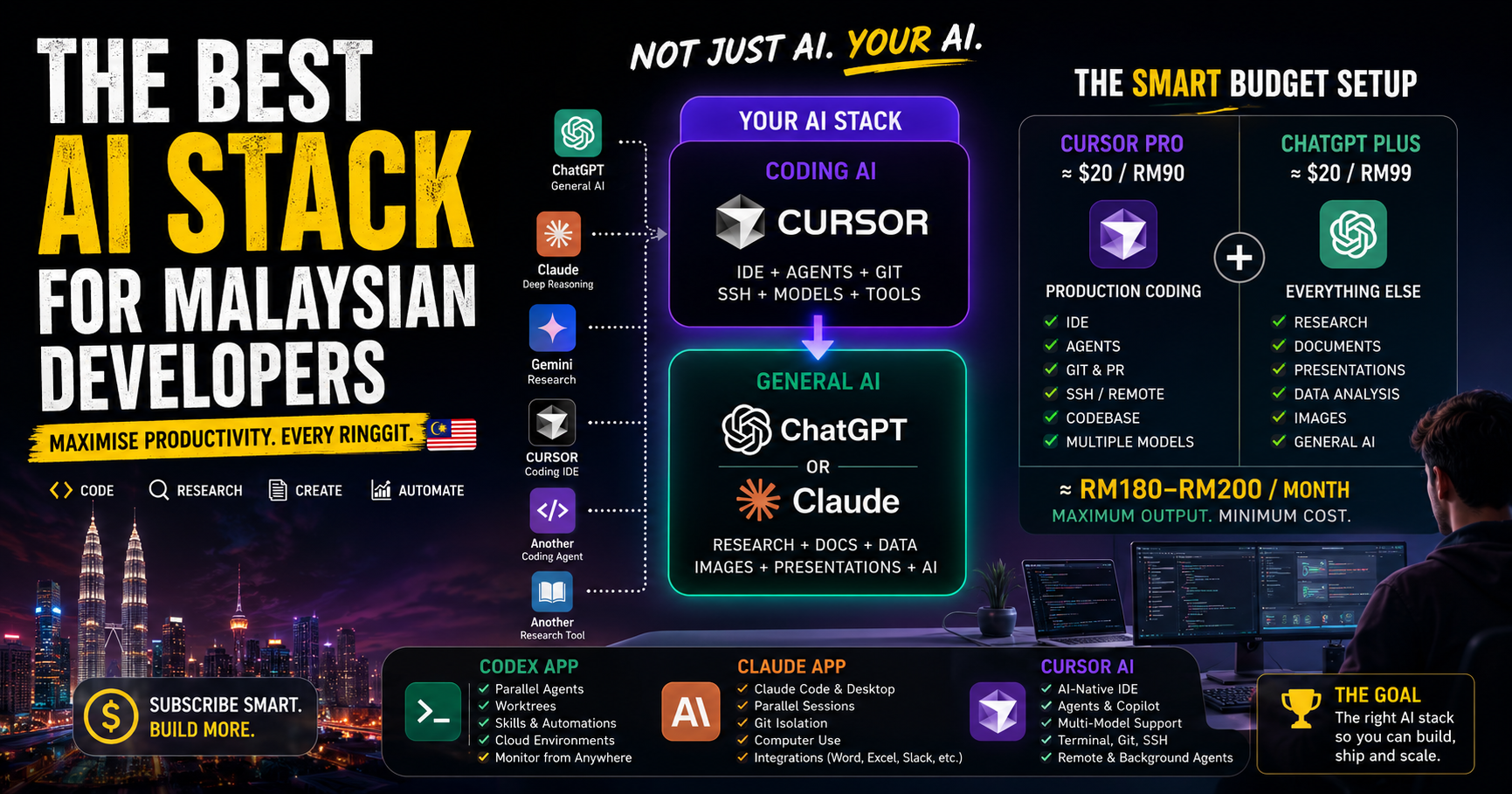
The Malaysian Economics: Why $60 for One AI Tool Doesn't Make Much Sense to Me
This is where geography actually matters.
If you're reading this from the United States, $60/month for an AI subscription might feel like:
"It's just $60."
But I'm writing this from Malaysia.
And when you're paying in Ringgit, the opportunity cost is different.
At roughly RM4+ to USD1, a:
$60/month AI subscription
is already around:
RM250+ every month.
That's:
RM3,000+ per year.
And that's before considering SST, exchange-rate fluctuations, bank conversion fees, or changes in subscription pricing.
Suddenly, the question becomes much more interesting.
The Malaysian Developer Has a Budget Problem
Let's say I give myself:
RM250/month for AI.
I have two very different ways of spending it.
Option A
Cursor Pro+
≈ $60
≈ RM250+
I get more Cursor usage.
That's useful.
But my entire AI budget is concentrated inside one ecosystem.
Option B
Cursor Pro + ChatGPT Plus
Cursor Pro       ≈ $20
ChatGPT Plus     ≈ $20

Total            ≈ $40
That's roughly:
RM170–RM180/month, depending on exchange rate and billing.
And I still have approximately:
$20 / RM80+
left over.
Now look at what I actually have.
flowchart TB
    BUDGET["🇲🇾 AI Budget<br/>~RM250 / month"]

    BUDGET --> CURSOR["⚡ Cursor Pro<br/>~$20"]

    BUDGET --> CHATGPT["🧠 ChatGPT Plus<br/>~$20"]

    BUDGET --> REMAINING["💰 Remaining Budget<br/>~$20"]

    CURSOR --> CMODELS["Cursor Model Usage"]
    CURSOR --> API["$20 API-priced Usage"]
    CURSOR --> IDE["AI IDE"]
    CURSOR --> AGENT["Coding Agent"]
    CURSOR --> TOOLS["Developer Tools"]

    CHATGPT --> FRONTIER["Frontier Models"]
    CHATGPT --> CODEX["Codex"]
    CHATGPT --> RESEARCH["Research"]
    CHATGPT --> DOCS["Documents"]
    CHATGPT --> DATA["Data"]
    CHATGPT --> IMAGE["Images"]

    REMAINING --> FLEX["API / Specialist Tool / Extra Usage"]
This is why I personally struggle to justify paying the entire $60 for Cursor Pro+.
Cursor Pro Is Already Doing the Important Part
This is where I don't want people to misunderstand my argument.
I'm not saying Cursor Pro is weak.
I'm saying:
Cursor Pro already gives me what I actually need for production coding.
Cursor Pro currently combines its own included model usage with $20 of API-priced model usage, depending on the model and usage pool. (docs.cursor.com)
And then I have Cursor's actual development environment:
- AI-native IDE
- Agent mode
- Composer
- Model selection
- Git
- Terminal
- SSH / remote development
- Browser/tool integration
- MCP
- Background/cloud agents
- Codebase context
- PR workflows
That's already a ridiculous amount of capability for a developer.
So the question isn't:
"Would I like more Cursor usage?"
Of course I would.
The question is:
"Would I rather have more Cursor usage, or another entire AI ecosystem?"
For me, that's where Cursor Pro+ starts losing its appeal.
I Don't Need a Frontier Model to Type My Code
This is probably the most important technical point in my argument.
I don't need the smartest model in existence to write every line of my production code.
Why?
Because I'm not asking the AI:
"Design my entire company."
I'm doing the engineering.
I decide:
- Architecture
- Stack
- Infrastructure
- Database
- APIs
- Security
- Deployment
- Service boundaries
- Engineering constraints
I can use a frontier model when I need help reasoning about those decisions.
Once I have made the decision and written a detailed implementation plan, the problem becomes much simpler.
flowchart LR
HUMAN["👨💻 Engineer"]
HUMAN --> DECISION["Architecture<br/>Stack<br/>Constraints"]
DECISION --> FRONTIER["🧠 GPT / Claude Frontier"]
FRONTIER --> PLAN["IMPLEMENTATION_PLAN.md"]
PLAN --> CURSOR["⚡ Cursor"]
CURSOR --> COMPOSER["Composer 2.5"]
CURSOR --> GROK["Grok 4.5"]
CURSOR --> CMODELS["Cursor Models"]
COMPOSER --> IMPLEMENT["Implementation"]
GROK --> IMPLEMENT
CMODELS --> IMPLEMENT
IMPLEMENT --> TEST["Tests"]
TEST --> SHIP["🚀 Production"]
This is the key.
I want frontier intelligence for thinking.
I want efficient intelligence for execution.
Why Composer 2.5 and Grok 4.5 Are Enough
Cursor's own coding models are exactly what make this strategy work.
Composer 2.5 is designed around coding and agentic workflows.
Cursor also provides access to models such as Grok 4.5 alongside OpenAI and Anthropic models. (cursor.com)
And honestly?
For implementation work, good enough is extremely good.
If I've already written:
# Authentication Service

## Architecture

...

## Database

...

## API

...

## Middleware

...

## Security

...

## Tests

...

## Implementation Steps

1. ...
2. ...
3. ...
I don't need to burn expensive frontier inference telling the model:
"Create
auth_service.py."
I need an agent that can:
- Understand the repository
- Follow the plan
- Modify files
- Run tests
- Read errors
- Fix mistakes
- Repeat
That's exactly where an efficient coding model shines.
The Frontier Model Becomes the Architect
This creates a really clean division.
flowchart TB
FRONTIER["🧠 GPT-5.6 Sol / Opus 5"]
FRONTIER --> THINK["Think deeply"]
THINK --> ARCH["Architecture"]
THINK --> TRADEOFF["Trade-offs"]
THINK --> SECURITY["Security"]
THINK --> EDGE["Edge Cases"]
THINK --> PLAN["Detailed Plan"]
PLAN --> CURSOR["⚡ Cursor"]
CURSOR --> EXEC["Execute"]
EXEC --> CODE["Code"]
EXEC --> TEST["Tests"]
EXEC --> DEBUG["Debug"]
EXEC --> DIFF["Diff"]
DIFF --> HUMAN["👨💻 Human Review"]
This is much more efficient than:
GPT-5.6 Sol
    ↓
Every single code generation
    ↓
Every single file edit
    ↓
Every terminal command
    ↓
Every debugging iteration
Why pay frontier prices for every step if only a handful of steps actually require frontier-level reasoning?
The "Subsidised Frontier" Strategy
This is where the subscription economics become interesting.
Instead of paying for the most expensive model continuously inside Cursor:
flowchart LR
    PLAN["🧠 Frontier AI"]

    PLAN --> CHATGPT["ChatGPT Plus"]
    PLAN --> CLAUDE["Claude Pro"]

    CHATGPT --> SPEC["Specification"]
    CLAUDE --> SPEC

    SPEC --> CURSOR["⚡ Cursor Pro"]

    CURSOR --> CHEAP["Efficient Coding Models"]

    CHEAP --> CODE["Large Volume Implementation"]
I'm effectively using my general AI subscription to subsidise my expensive reasoning workload.
And Cursor's subscription handles the high-volume execution workload.
That is the architecture.
$60 Cursor Pro+ vs $40 Cursor + General AI
Let's make the comparison brutally simple.
Option A — Cursor Pro+
$60 / month
≈ RM250+

        ↓

Cursor Pro+
You get:
- More Cursor usage
- Cursor IDE
- Cursor Agent
- Cursor models
- Multiple model providers
- Developer tooling
- Higher usage limits
Excellent if you are absolutely hammering Cursor.
Option B — Cursor Pro + ChatGPT Plus
$20              $20
Cursor            ChatGPT

        ↓

       $40
Approximately:
RM170–RM180/month
And you get:
Cursor
- Cursor model usage
- $20 API-priced usage
- Composer 2.5
- Grok 4.5
- Other model providers
- Agent
- IDE
- Git
- SSH
- Terminal
- Browser/tools
- Cloud/background agents
ChatGPT
- Frontier reasoning
- Codex
- Research
- Data analysis
- Documents
- Presentations
- Images
- General AI
- Additional agentic workflows
And you still have:
~$20 of your original budget left.
The Difference Is Not $20
This is the important economic insight.
The difference isn't:
$60 - $40 = $20
The real difference is:
ONE ECOSYSTEM
        vs
TWO ECOSYSTEMS
flowchart TB
    MONEY["~$40"]

    MONEY --> ONE["ONE AI ECOSYSTEM"]

    ONE --> CURSOR1["Cursor"]
    CURSOR1 --> MORE["More Cursor Usage"]

    MONEY --> TWO["TWO AI ECOSYSTEMS"]

    TWO --> CURSOR2["Cursor"]
    TWO --> GENERAL["ChatGPT / Claude"]

    CURSOR2 --> CODING["Coding"]
    GENERAL --> THINKING["Planning + Research + General AI"]
That's a massive difference.
And You Get Two Coding Agents
This is the part I think gets overlooked.
With:
Cursor + ChatGPT
You effectively have:
flowchart TB
DEV["👨💻 Developer"]
DEV --> CURSOR["⚡ Cursor"]
CURSOR --> CAGENT["Cursor Agent"]
CURSOR --> COMPOSER["Composer 2.5"]
CURSOR --> GROK["Grok 4.5"]
DEV --> CODEX["🟢 Codex"]
CODEX --> PARALLEL["Parallel Agents"]
CODEX --> WORKTREE["Worktrees"]
CODEX --> SKILLS["Skills"]
CODEX --> AUTOMATION["Automations"]
And if I choose Claude instead:
flowchart TB
DEV["👨💻 Developer"]
DEV --> CURSOR["⚡ Cursor"]
CURSOR --> AGENT["Cursor Agent"]
CURSOR --> COMPOSER["Composer 2.5"]
CURSOR --> GROK["Grok 4.5"]
DEV --> CLAUDE["🟠 Claude"]
CLAUDE --> CODE["Claude Code"]
CLAUDE --> COWORK["Cowork"]
CLAUDE --> AGENT2["Claude Agent"]
Now I have two independent coding environments/agents.
That's valuable.
Your Cursor Limit Is No Longer a Single Point of Failure
And this is where the two-subscription strategy becomes even better.
Imagine it's the last week of the month.
You've hammered Cursor.
Your usage is getting close to its limits.
With only Cursor:
Cursor usage exhausted
        ↓
😐 Wait for reset
With Cursor + ChatGPT:
flowchart LR
    CURSOR["Cursor"]

    CURSOR --> LIMIT["Usage Limit"]

    LIMIT --> CODEX["Codex"]

    CODEX --> CONTINUE["Continue Coding"]

    CURSOR --> RESET["Next Billing Cycle"]
Or:
Cursor limit
     ↓
Claude Code
     ↓
Keep working
Your second subscription becomes overflow capacity.
That matters when AI is part of your daily production workflow.
Why This Matters More in Malaysia
This is where I think the Malaysian context is important.
We're not talking about:
"$60 is nothing."
We're talking about:
RM250+ every month.
Over one year:
$60 × 12 = $720

≈ RM3,000+
That's a meaningful recurring expense.
Compare:
Cursor Pro+
≈ $720/year
≈ RM3,000+/year
versus:
Cursor Pro
+
ChatGPT Plus

≈ $480/year
≈ RM2,000+/year
That's approximately:
$240/year saved
or roughly:
RM1,000/year
depending on exchange rates, taxes and billing.
And you're not getting less AI.
You're getting different AI capability.
RM1,000 Is Not Nothing
For a Malaysian university student, junior developer, freelancer or early-career engineer, RM1,000/year is significant.
That money could instead pay for:
- Cloud hosting
- VPS
- Domain names
- Database hosting
- GitHub services
- A monitor
- SSD storage
- RAM
- Development hardware
- Courses
- Books
- API credits
- Other developer tools
So when somebody says:
"Just buy the $60 plan."
My question is:
Why?
What am I actually gaining for that additional $20/month?
If the answer is simply:
"More Cursor usage."
Then I have to compare that against:
A completely separate AI ecosystem for the same money.
The Malaysian AI Stack I Would Actually Recommend
For someone doing production development every day:
flowchart TB
    DEV["🇲🇾 Malaysian Developer"]

    DEV --> CURSOR["⚡ Cursor Pro<br/>~$20"]

    CURSOR --> BUILD["BUILD"]
    BUILD --> COMPOSER["Composer 2.5"]
    BUILD --> GROK["Grok 4.5"]
    BUILD --> CURSORMODELS["Cursor Models"]
    BUILD --> IDE["IDE + Agent + Git + SSH"]

    DEV --> GENERAL["🧠 ChatGPT Plus<br/>~$20"]

    GENERAL --> THINK["THINK"]
    THINK --> FRONTIER["GPT Frontier"]
    THINK --> CODEX["Codex"]
    THINK --> RESEARCH["Research"]
    THINK --> DOCS["Documents"]
    THINK --> DATA["Data"]
    THINK --> IMAGE["Images"]

    BUILD --> SOFTWARE["🚀 Production Software"]
    THINK --> SOFTWARE
And if you prefer Claude:
🇲🇾 Malaysian Developer

       │
       ├── Cursor Pro
       │      └── Build
       │
       └── Claude Pro
              ├── Think
              ├── Research
              ├── Claude Code
              └── Cowork
The Rule I Would Use
Here's my rule for AI subscriptions:
Don't buy the most expensive model for the entire pipeline.
Instead:
flowchart LR
    REQUIREMENTS["Requirements"]
    REQUIREMENTS --> REASON["🧠 Expensive Reasoning"]

    REASON --> PLAN["Architecture / Plan"]

    PLAN --> EXECUTE["⚡ Cheap Efficient Execution"]

    EXECUTE --> TEST["Test"]

    TEST --> REVIEW["🧠 Smart Review"]

    REVIEW --> SHIP["🚀 Ship"]
Use expensive intelligence where the cost of being wrong is high.
Use efficient intelligence where the cost is mostly generating and manipulating code.
That is how you get more work done for the same money.
The Final Malaysian Calculation
If I have roughly RM250/month available:
❌ I don't immediately spend it all on Cursor Pro+.
Instead:
✅ Cursor Pro
~$20
~RM80–90
For:
BUILD
✅ ChatGPT Plus
~$20
~RM80–90
For:
THINK + RESEARCH + GENERAL AI + CODEX
💰 Remaining
~$20
~RM80–90
For:
API credits / specialist tools / another service / saving it
That gives me:
flowchart TB
    RM["~RM250 AI Budget"]

    RM --> BUILD["~RM85<br/>Cursor Pro"]

    RM --> THINK["~RM85<br/>ChatGPT Plus"]

    RM --> FLEX["~RM85<br/>Flexible Budget"]

    BUILD --> B["Coding"]
    THINK --> T["Reasoning + Research + General AI"]
    FLEX --> F["Extra Infrastructure / Tools"]
And that's a much better capability-per-Ringgit proposition.
So Is Cursor Pro+ Bad?
No.
If you're constantly hitting Cursor's limits and Cursor is effectively your entire development environment, Cursor Pro+ can absolutely be worth it.
I'm not arguing that $60 is objectively bad.
I'm arguing that:
For my workflow, $60 concentrated into Cursor isn't the best allocation of my AI budget.
I'd rather have:
Cursor Pro + ChatGPT Plus
than:
Cursor Pro+
because I'm not only coding.
I'm:
- Designing systems
- Researching technologies
- Writing documentation
- Creating presentations
- Analysing data
- Generating images
- Planning architecture
- Reviewing implementations
- Automating tasks
- Coding
- Debugging
- Managing infrastructure
I need an AI stack that reflects that.
The Real Optimization
This is the final idea I want readers to take away.
The goal isn't:
Maximum tokens.
It isn't:
Maximum model intelligence.
And it isn't:
Maximum number of subscriptions.
It's:
                 MAXIMUM
             ┌──────────────┐
             │ Useful Work  │
             └──────┬───────┘
                    │
                    ▼
             MINIMUM COST
Or more simply:
Maximum capability per Ringgit.
For me, that means:
Cursor
  ↓
Efficient execution

ChatGPT / Claude
  ↓
Frontier reasoning + general AI

Codex / Claude Code
  ↓
Backup + second coding agent

Human
  ↓
Architecture + judgement
And that's why I don't think the smartest move is necessarily buying the $60 Cursor tier.
I would rather build a two-AI system where each subscription does a different job.
Let the frontier model think.
Let Cursor execute.
Let the second agent provide redundancy.
And let your Ringgit buy capability, not just more tokens.
Comments
No comments yet. Be the first.